Saturday, 30 June 2007

Hadith 2 - The Religion (Islam) Is to act with sincerity.

اسلام عليكم و رحمة الله وبركات

Hadeeth 2:

الدين النصيحة

"The religion (Islam) is to act with sincerity" or " Religion is advice"

Tarkeeb:-
الدينMubtada
النصيحةKhabar

Mubtada and khabar makes a Jumlah Ismiyyah Khabariyah (Nominal sentence)

The Arabic word Al-Nasihah is difficult to translate into English.

Allama Ibn Daqeeq al Eid رحمة الله عليه states that “In Arabic there is no similar for the word Al-Nasihah also”

Other meanings could be – giving good advice, directing towards good, acting with sincerity or honesty, or being compassionate and desiring good.

The hadith makes clear that one of the core aspects of true faith is to give good counsel, to wish well, and to act towards everything with honesty and sincerity.

[Provisions For The seekers - Abdur Rahman Ibn Yusuf Mangera]

Imam Nawawi رحمة الله عليه states that:

“This hadith is an explanation for the entire religion as nasihah means sincerity, and sincerity is the root of all actions. Without it (sincerity) all actions are rejected”

[Sharah Muslim – Fathul Bari]

In the rest of the hadith, the sahabah asked Muhammad صلي الله عليه وسلم, in regards to what must this naseehah (sincerity) be?

Muhammad صلي الله عليه وسلم answered;

In regards to Allah;

In regards to the Book of Allah (Quran);

In regards to the Imam’s of the Muslimeen; and

In regards to the Muslim’s as a whole.

To have sincerity in regards to Allah means to believe in Allah with all his sifaat (attributes), and believe firmly in His oneness.

Not to associate anything or anyone else with the attributes of Allah. To do all worship with utmost sincerity. To act upon all that Allah has commanded and be thankful for all the blessings Allah has blessed us with. To love all those who love Allah.

To have sincerity in regards to the Quran means to believe firmly that the Quran has been revealed from Allah. To act upon whatever it says in all states. To recite it with tajweed and to contemplate in what the ayah’s say. To respect it at all times.

Inclusive in regards to Allah and His book are the sincere belief we must have in regards to Muhammad صلي الله عليه وسلم, To believe firmly that Muhammad صلي الله عليه وسلم is the messenger of Allah, to bring Imaan in his Prophet hood, to believe in all the commands He صلي الله عليه وسلم has given and to follow what He صلي الله عليه وسلم has taught. To love Him صلي الله عليه وسلم more than one’s own family and children, and to have love for His صلي الله عليه وسلم sahabah (companions).

In regards to Muslim Imam’s, it constitutes to those who are running the country as well the ulema (people of knowledge). To be sincere in dealing with these people means to stay loyal to them, not to go against them in order to cause them difficulty in their rule.

To follow them in good matters and to refrain from following in bad.

If it is felt that they are doing some wrong then they must be advised in a good way and the people should not plot against them.

To respect the people of knowledge, to accept all they say about the deen and to follow them in all the good they say about the deen, and in their actions.

In terms of the general muslmeen it means to always want good for them in terms of both worlds, and to call them to good so that they may benefit in all walks of life. To never harm them, to reply to their salaam, to visit them if they are ill, not betray anybody’s trust, to respect the elders and have mercy on the young, not to backbite etc.

In this manner all things in regards to this world and the hereafter are included.

This hadith shows how Muhammad صلي الله عليه وسلم was blessed as being Jawaamiul Qalam, meaning He صلي الله عليه وسلم could say so less and it would have a very deep and profound meaning, this was indeed a miracle of the Prophet صلي الله عليه وسلم that he could convey so much with such a short sentence.

Monday, 11 June 2007

Hadeeth 1- Deeds are Only by Intentions

اسلام عليكم و رحمة الله وبركاته

بسم الله الرحمن الرحيم

Hadeeth 1

قَالَ النَّبِيُّ صَلَي اللهُ عَلَيْهِ وَ سَلم

انما الاعمال بالنيات و انما لامرئ ما نوي فمن كانت هجرته الي الله و رسوله فهجرته الي الله و رسوله، ومن كانت هجرته الي دنيا يصيبها أو إمرأة يتزوجها فهجرته الي ما هاجر اليه

رواه بخاري و مسلم

Translation:

The Prophet صلي الله عليه وسلم said:

"Deeds are only by intentions, for each man is only for which he has intended, and so whoevers hijrah is for Allah and his messenger صلي الله عليه وسلم, then indeed his hijrah is only to Allah and his messenger صلي الله عليه وسلم. But whoevers hijrah is to the world he wishes to acquire or a woman he seeks to marry, then his hijrah is only to that which he has actually immigrated."

[Bukhari and Muslim]

Before beginning to explain this hadeeth it is important that we actually understand what the words niyyah and hijrah actually mean. One can say that a niyyah means inclination of the heart. So our intention of any act that we do lies upon the inclination of our hearts. The word hijrah means to leave a land solely for the pleasure of Allah سبحانه وتعالي. The more correct and general meaning is that a person leaves all which Allah سبحانه وتعالي has fordibidden.

Explanation:

This hadeeth indicates towards a certain incident that took place. A man migrated to Madinah with the desire to marry a woman whose name was Umme Qays. For this reason the man was later well known as 'Muhajir Umme Qays'. What actually happened was a man sent a message to Umme Qays stating his desire to marry her. Umme Qays accepted with a condition that he migrate to Madinah for the marriage to take place. Therefore, the man migrated to Madinah and then married her. Hence he became famous with the title 'Muhajir Umme Qays'.

Within this beautiful hadeeth lies many virtues. Imam Shafiee رحمة الله عليه and Imam Ahmad رحمة الله عليه have given this hadeeth the status of being equivalent to a third of all knowledge.

Our actions are divided into three:

1-Those acts which are connected to the heart.

2-Those acts connected to our tongues.

3-Those acts connected to aur body parts.

This hadeeth relates to all three types. Than any act done within the three categories above is still determined by our intentions.

Ibn Daqeeq Al'eid رحمة الله عليه has said that the 'Ulama have titled this hadeeth 'ثلث الاسلام' (a third of Islam). Whereas Imam Abu Daud رحمة الله عليه has described this hadeeth to be a half of all Fiqh (Jurisprudence). It is a tradition amongst 'Ulema that they begin their books with this hadeeth so that from the very beginning the teacher and the student can rectify their intentions, as well as ensure whatever they are commencing is done with full sincerity.

Intentions play an important part in our lives, and we can class them into three categories according to why intentions are needed:

1-تمييز عبادت عن العادت To differentiate our habits from our acts of worship ('ibaadah). It is our intentions that truly determine why we are doing certain acts. A person can stand in the position of salah, but without a niyyah he is merely standing. It is only his niyyah that will determine whether or not he is really praying.

2-تمييز عبادت عن العبادت Our intentions differentiate one act of worship from another. A person can be praying Salah, however only through his niyyah will it be known whether he is praying for example fajr or dhuhr.

3-تمييز معبود عن المعبود Only our intentions will tell us to whom we are praying to. It differentiates us from others. Our niyyah will tell us we are praying to Allah. Whereas the intention of a fire worshipper would be that he is praying towards the fire.

The meaning of the hadeeth here is that Allah سبحانه وتعالي will only accept those acts of worship which are done with a correct intention. If the intention is not correct, then the act is not accepted rather it is rejected. However a person intends will be in accordance to what he will recieve. For any act, no matter how many intentions a person has for it they will all be dealt with accordingly. For example if a person has a relative who us very poor he intends to help him because he is poor, this results in one reward. However, if a person also intends to enjoin family ties as mentionned in the Qur'an and hadeeth he will get two rewards. A person can have many intentions for one act, and if they are all good intentions the Allah will reward us for all of them.

We will bear the fruit of our actions according to our intentions. So we must constantly be reviewing our intentions and making sure that sincerity is found within them.

Friday, 16 March 2007

About the Author *UPDATED & COMPLETED*

اسلام عليكم و رحمة الله وبركاته

Before commencing to translate and explain any hadeeth, a brief introdution about the author and the book (kitaab) itself is needed. This book is called:

زاد الطالبين

"Zaadut Talibeen" known as Provisions for the Seekers in English.

About the Kitaab (Book) -

This book is a collection of 327 sayings (ahadeeth) of the Prophet صلي الله عليه وسلم. This is one of the first books of ahadeeth to be taught in the 'ilmiyyah course. When this book is taught students are often required to memorise each hadeeth off by heart as well as learn their gramatical structures. Insha'Allah this blog can be a means of anyone and everyone accessing the ahadeeth to memorise them and understand them fully. The Ahadeeth from this book have been selected from the famous book of hadeeth Mishqaat Al Masabeeh. Insha'Allah I will post the references to each hadeeth for those wanting to study the hadeeth in more depth.

About the Author-

The full name of the author is Moulana 'Ashiq Ilaahi al-Bulandshehri ibn Muhammad Siddique ibn Asadullah رحمة الله عليه. This respected author had an uncle (whose name was Muhammad Isma'eel رحمة الله عليه who pledged allegiance to Hadhrat Gangohi رحمة الله عليه. I have mentioned this to let readers understand what sort of a pious background the author had. Moulana 'Ashiq ilaahi was blessed with the presence of his father for quite some time in his life. His father read many of his kitaabs that he had written as well as going to Darul 'Uloom Karachi with him where he passed away. His father was buried in darul 'uloom Karachi's graveyard.

His father was a very hardworking person who strived hard in the upbringing of his children. The fruit of his hard work can be seen in the excellent works of his children. It was his father that ensured he memorised the Qur'an, learnt Arabic, and even went to the extent of sending him to out of town Madaaris to further increase his 'ilm. Even though the family were not well off and lived in hard conditions his father still ensured he carried on trying to learn and broaden his knowledge.

Moulana 'Ashiq Ilaahi al-Bulandshehri (رحمة الله عليه)'s mother passed away when he was only five years of age. For this reason he was brought up by his grandmother and father. Moulana 'Ashiq Ilaahi al-Bulandshehri رحمة الله عليه was born in 1343 a.h and completed the memorisation of the entire Qur'an in 1355 a.h by the tender age of eleven. Due to the hard efforts of his father he was also later enrolled at various institutes to complete his studies in Islam where he later graduated as an 'Aalim.

When Moulana Ashiq رحمة الله عليه enrolled at Madrassah Imdaadiyah in Muraad-abaad his grandmother passed away [May Allah shower his mercy over her grave]. Moulana Ashiq Ilaahi رحمة الله عليه upon gaining his 'ilm taught at many Darul 'Ulooms as well as writing many kitabs. Later on in his life he also went on to writing fatawa.

Here is some more about the author written by whitethreadpress.com:

A prolific writer and eminent scholar of the Indian Subcontinent, ShaykhAshiq Ilahi al Bulandshehri (or al-Barni) رحمة الله عليه was born in 1343 ah in Bulandshehr of Uttar Pradesh. After attaining his primary education at Madrasa Imdadiyya Moradabad and Jami‘ Masjid Aligarh, he traveled to MazahirUlum Saharanpur in pursuit of higher knowledge.

After completing his studies, he taught various subjects at Ferozpur Jhirka, Hayat al-Ulum Moradabad, and at different madrasas throughout Calcutta. He later taught at Dar al-‘Ulum Karachi for several years at the request of Mufti Muhammad Shafi’ رحمة الله عليه, where he assumed responsibility of the fatwa department and taught students hadith and tafsir. The Shaykh later migrated to Madina, wherehe spent the last 25 years of his life.

He was a disciple of the hadith scholar Shaykh Muhammad Zakariyya Kandhlawi رحمة الله عليه. ozens of his books have been well received in many countries. Tohfa-e khawatin (Gift for omen), Marne ke bad kya hōga? (What is going to happen after death?), Islami adab (Islamic conduct), Huquq al-walidayn (Rights of parents), and Anwar al-bayan (Illuminating discourses on the Holy Qur’an), a voluminous commentary of the Qur’an, are among the well-known books he authored. In the field of hadith, he authored Zad al-talibin (Provisions for the seekers) and Al-Fawa’id al-saniyya fi sharh al-Arba‘in al-Nawawiyya (The lofty beneficial points in the explanation of Nawawi’s Forty Hadiths).

As for jurisprudence, he is the author of Al-Tashil al-daruri fi masail al-Quduri (The necessary facilitation of the laws of Quduri), as well as dozens of reformative booklets and articles. He passed away in the illuminated city of Madina at the age of 80 and was buried there in the Baqi‘ graveyard, as had been his desire.

Moulana 'Ashiq Ilaahi رحمة الله عليه has done a great deed in writing this kitaab. Alhamdulillah it has become a well accepted kitaab in many Darul 'Ulooms. May Allah reward Moulana Ashiq 'Ilaahi for his efforts. Ameen

Wednesday, 14 March 2007

What Next?

Assalau Alaykum,

After graduating from Madrassah, a new journey had to be embarked. One that involved practising and spreading what had been passed onto us by our respected teachers. Not much thought had been put into what we would do next with the knowledge we had gained. After much thought we decided that a way in which we could spread some 'ilm, would be to go through one of the beautiful collections of ahadeeth
:

زاد الطالبين
"ZAD al-TALIBEEN (Provisions for the Seekers)"

The first project of this blog is go through each and every hadeeth of this book and to elaborate on its meaning as best we can. We will clearly state all references and where we state our own analogies. I pray that Allah guides us and aids us in this small effort of ours to spread the knowledge we have gained. Ameen

I will not write any hadeeth on this blog until i have memorised it with the intention that Allah gives me the full understanding of every hadeeth. I seek forgiveness for any mistakes that may be found on this blog and I hope that readers will notify me of any mistakes that are found. I hope that the readers can too learn the ahadeeth off by heart.

I apologise in advance for the fact that it may take time for me to post. I pray that Allah grants every reader patience. Ameen

In the next post I will write a bit about the author of the book and what sorts of ahadeeth are found in this book insha'Allah.

Wassalam
____________

Friday, 2 March 2007

Where did the name of the blog orginate?

Assalamu Alaykum,
Behind the name of this blog lies a story which I wish to share....
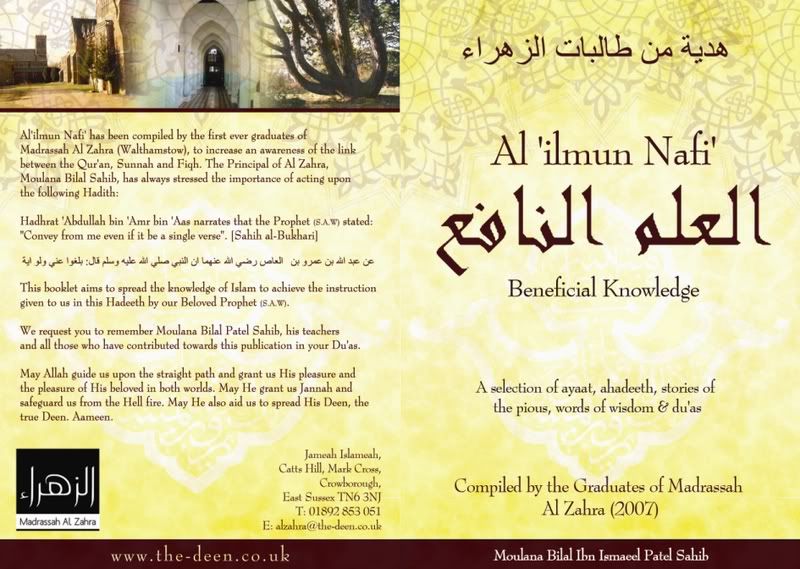
Some of the posters on this blog are graduates of Madrasah Al Zahra. In our final year we wrote a book as a class as a small token of appreciation to our Principal who guided us throughout the seven years, with the tawfiq of Allah, whilst we were at the Madrassah. The name of the book was: Al 'ilm al-Nafi' which one member of the class came up with. After much help from many people here it is for everyone to read:

(Click on the book for the link)

After graduating many of us didn't know how to reach out to people with our knowledge. We really wanted to act upon the Hadith of the Messenger (Peace and blessings be upon him):

بلغوا عني ولو اية

"Spread from me even if it be a single ayah".

After much help, support and ideas from the people we knew, a Sister came up with the idea that we start a blog. So, Alhamdulillah that is exactly what we have done. However, deciding on a name was quite hard! After much thought, we came to a decision that what name could be better than the name of the book we wrote:


"Al'ilmun Nafi-Beneficial Knowledge"


Having the blog the same name as the book is just a mark from us to that our work hasn't stopped with the booklet. Insha'Allah, we aim to get the message of the true Deen (religion) Islam far and wide to all corners of the world.

I urge all readers to constantly make du'aa (to supplicate) to Allah the Almighty, that He help us to deliver to others only that which is haqq (the truth).

Many of us will be posting on the blog. I urge all readers to notify us of any mistakes and to keep yourselves updates with the blog.

May Allah truly make this a means of attaining some beneficial knowledge. Ameen
Wassalam
____________